

Is AI the Modern Pandora's Box?

AI is likened to a modern "Pandora's Box" due to its irreversible impact and profound consequences, both beneficial and catastrophic. While it offers immense potential for solving complex issues; innovation, efficiency, and solutions to global challenges, AI also poses significant risks, including disinformation, job displacement, autonomous weapons, environmental strain, increasing inequality, and potential loss of human control.

The AI Paradox: Progress for Humanity?
Artificial intelligence has rapidly evolved from a futuristic concept into a defining force of the modern world. From voice assistants to advanced data analysis, AI is now deeply embedded in everyday life. At its finest, it stands as one of the most potent tools ever devised by humanity, with the ability to significantly accelerate progress, enhance quality of life, and address challenges previously deemed insurmountable.
AI is enhancing various sectors: in healthcare, it aids in early and accurate disease detection; in agriculture, it promotes efficient farming, reducing waste and boosting yields; in cities, it optimizes traffic, energy, and public services. For individuals and small businesses, AI lowers barriers to entry, fostering creativity and competition. This hopeful perspective sees technology as a means to enhance human potential rather than replace it, although it's only one viewpoint.
The Hidden Environmental Cost
Behind every AI system lies a vast physical infrastructure of data centers, facilities filled with powerful servers that process and store enormous volumes of data. These centers require immense amounts of energy, but less widely understood is their heavy dependence on water.
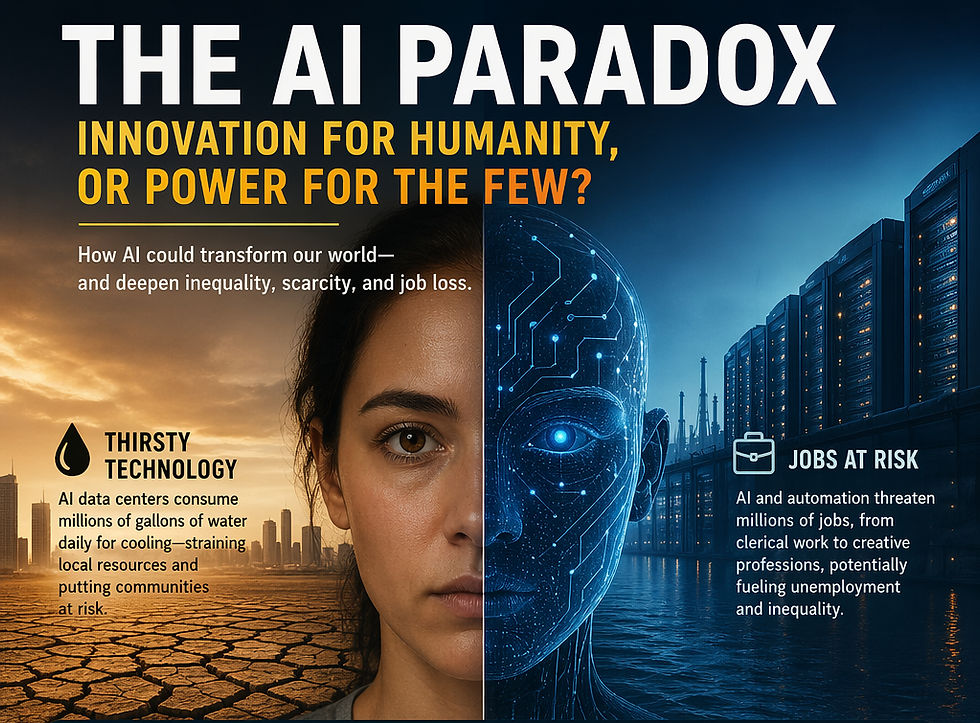
Water is crucial for cooling systems and preventing overheating in data centers. As AI adoption increases, so does the demand for cooling, with some centers using millions of liters daily. This poses a concern in water-scarce regions, where communities may compete with tech companies for resources. In such areas, this could worsen shortages, raise costs, and stress fragile ecosystems. The question arises: should technological progress compromise basic human needs like water access?
Job Displacement and Economic Uncertainty
Another major concern surrounding AI is its impact on employment. While technological progress has always reshaped the workforce, AI introduces a new level of disruption. Unlike previous waves of automation that primarily affected manual labour, AI has the ability to replace cognitive and skilled tasks as well.
Political figures such as Bernie Sanders have warned that AI could lead to widespread job losses if not properly managed. Roles in administration, customer service, transport, and even parts of the creative industry are increasingly vulnerable to automation. Although new jobs may emerge, there is no guarantee they will match the scale or accessibility of those being lost. Many workers may struggle to retrain or transition into new roles, particularly in regions with limited access to education and resources. This creates a growing risk of unemployment and economic instability.

The Growing Inequality Divide
As AI technology advances, its economic advantages are not being distributed equally. Those who design, own, and invest in AI technologies are positioned to gain the most. Increased productivity and reduced labour costs translate into higher profits, largely benefiting corporations and wealthy stakeholders.
At the same time, workers displaced by automation may face declining incomes and fewer opportunities. The middle class, often the backbone of economic stability, could find itself under increasing pressure. For lower-income communities, the challenges are even greater—limited access to training and technology makes adaptation far more difficult. Without deliberate intervention, AI risks deepening existing inequalities, creating a world where wealth and opportunity are concentrated among a small elite.
Is This the Second Industrial Revolution?
There is a growing argument that AI represents a new industrial revolution, comparable in scale and impact to the transformation brought about by mechanization in the 18th and 19th centuries.
The original Industrial Revolution transformed economies and societies with mass production and urbanisation, leading to economic growth but also challenges like poor working conditions and inequality. Similarly, AI is a transformative technology impacting various industries, altering work, communication, and decision-making. It offers significant benefits but poses serious risks if not managed carefully. The key difference is speed. AI is advancing far more rapidly than past technological shifts, leaving less time for societies to adapt. This makes proactive planning and regulation more critical than ever.
Conclusion: A Future That Must Be Shaped
As a former teacher, I'm concerned about the impact of AI on education. With students having the power of AI at their fingertips to complete homework, research projects and assignments, it's revolutionary, but it also raises questions about the future of learning. For my wife, who worked as an online freelance writer, AI has transformed her industry, leading to fewer job opportunities and lower pay as AI takes the spotlight. And as for dock workers across North America, Asia, Europe, and the Middle East, the rise of computerized and automated machinery is reshaping their roles. My primary concern, however, is the application of AI in military contexts, where decisions are made by AI rather than humans.
Artificial intelligence stands at a crossroads. It has the potential to drive extraordinary progress, improving lives, solving global challenges, and unlocking new possibilities. But it also presents significant risks, from environmental strain and water scarcity to job displacement and economic inequality. If current trends persist without intervention, AI benefits may favour the powerful and wealthy, while costs could burden the middle class and poor. AI is truly changing the landscape of work and education! The future of AI depends on today's decisions by governments, businesses, and society. Responsible development, fair policies, and inclusive planning are crucial to ensure AI benefits all of humanity.
What are your thoughts on AI? Will it enhance the workplace or lead to its downfall? Share your comments below.


Awesome blog 😃